
Workshop Billing Guide — Job Cards, Estimates, and How to Stop Customer Fights
A customer walks into an electronics repair shop in Dhanbad with a mixer grinder that's not working. The guy at the counter — let's call him Sunil — picks it up, shakes it, opens the bottom, and says "₹500-600 lagega, 2 din mein ho jayega."
Four days later the customer returns. The bill is ₹1,200.
Fight at the counter. Voices raised. Other customers watching. The customer says "tumne 500 bola tha." Sunil says "andar ka bearing bhi kharab tha, woh alag charge hai." Customer refuses to pay more than ₹600. Sunil refuses to return the mixer without full payment. Somebody calls the owner. The owner, to avoid a scene, gives a "discount" and charges ₹800.
Sunil is annoyed. The customer is annoyed. The owner lost ₹400. And this will happen again next week with a different customer.
I've watched this play out at repair shops, service centres, automobile garages, AC repair businesses — the pattern is identical every time. No written estimate. No approval. No breakdown of charges. And then surprise billing that nobody agreed to.
The fix isn't complicated. But it requires a system.
The job card — your single most important document
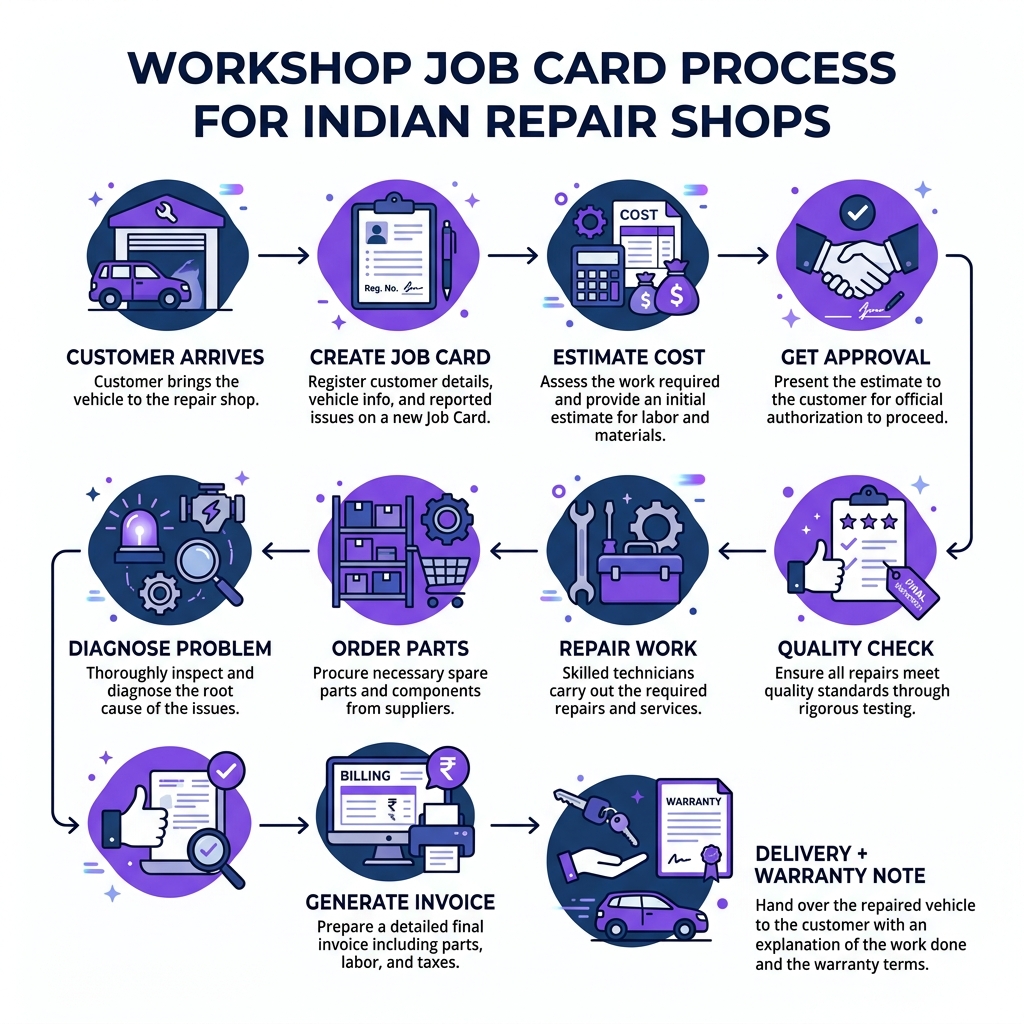
A job card is a receipt you fill out when a customer drops off an item for repair. That's it. Nothing fancy. But this one piece of paper prevents 90% of workshop disputes.
Here's what goes on a job card:
- Job card number — sequential, so you can track it (JC-0001, JC-0002, etc.)
- Date received
- Customer name and phone number
- Item description — "Bajaj Mixer Grinder, Model WX-9, Red colour, Serial No. [if visible]"
- Problem as described by customer — "Motor not starting, makes humming sound"
- Condition at receipt — THIS IS THE ONE EVERYONE FORGETS. Note any existing scratches, dents, missing parts. "Small crack on body near switch, left handle loose." Take a photo on your phone if possible.
- Estimated cost range — "₹500-800 (subject to inspection)"
- Estimated completion date — "2-3 working days"
- Customer signature
Give the customer a copy. Keep one for yourself. If you don't have carbon copy books, take a photo and WhatsApp it to them. Takes 2 minutes.
That condition note at point 6? Let me tell you why it's there. A TV repair shop in Ranchi fixed a customer's LED panel. Customer came to pick it up and said "yeh scratch pehle nahi tha." The shop had no proof. They ended up replacing the panel housing for free — ₹2,800 out of their pocket. If they had noted "existing scratch on lower-left frame" on the job card, this wouldn't have happened.
Written estimates — the ₹400 that saves you ₹4,000
Look, I understand why workshop owners hate written estimates. It slows things down. The technician has to inspect, calculate, write it up. Customers get impatient. "Bas bata do kitna lagega, itna formality kyun?"
Because that "formality" is the only thing standing between you and a screaming match at the counter.
Here's the process that works:
Step 1: Initial inspection. Your technician opens the device, identifies the problem, lists the parts needed. This should take 30 minutes to an hour for most small appliances, maybe half a day for automobiles or complex electronics.
Step 2: Written estimate. Write down — on paper or send via WhatsApp:
- What's wrong (in plain language, not technical jargon)
- What parts are needed, with individual costs
- Labour charges
- Total estimated cost
- How long it will take
Step 3: Customer approval. Call or message the customer. Get a "yes" before you start work. If they approve over WhatsApp, screenshot that message. If they come in person, get a signature on the estimate.
Step 4: Only then start repair work.
"But what if I find more problems after I start?"
Call the customer again. Explain what you found. Give a revised estimate. Get approval again. If they say no to the additional work, finish only what was approved and charge only for that.
This sounds tedious. It's not. It takes one phone call and protects you from disputes worth 10x that effort.
Parts vs. labour — always separate them on the bill
This is a hill I will die on. Never give a customer a single combined number for a repair. Break it down.
Bad: "Mixer grinder repair — ₹1,200"
Good:
- Motor bearing replacement — ₹350 (part)
- Carbon brush set — ₹120 (part)
- Labour charges — ₹400
- Inspection/diagnostic fee — ₹150
- Total: ₹1,020
See the difference? When the customer sees ₹1,200 as one number, their brain goes "that's too much for a mixer repair." When they see the breakdown, they can verify — "okay, bearing costs ₹300-400 in the market, carbon brushes are ₹100-150, so the parts cost is fair. Labour ₹400 for an hour's work seems okay."
Transparency kills suspicion. Suspicion kills repeat business.
By the way, this also protects you. If a customer argues about the total, you can point to each line item. "The bearing is ₹350, check Amazon if you want. The brush set is ₹120. I'm charging ₹400 for labour because this took me 45 minutes. Which part do you think is unfair?"
Most of the time, they have no answer. Because it IS fair. They just couldn't see it before the breakdown.
The inspection fee — charge it and don't feel guilty
A lot of repair shops inspect for free. The customer brings something in, your technician spends 20-30 minutes diagnosing the problem, then the customer says "theek hai, sochta hoon" and takes it somewhere else. Or worse — you diagnose, they take it to a cheaper shop and tell that shop exactly what's wrong.
You just gave away your expertise for free.
Charge an inspection fee. ₹100-₹200 for small appliances. ₹300-₹500 for electronics. ₹500-₹1,000 for automobiles. Make it clear upfront: "Inspection charge ₹200 hai. If you approve the repair, this gets adjusted in the final bill. If you don't want the repair, you pay only ₹200."
Some customers will walk away. Good. The ones who stay are serious, and your technician's time isn't wasted on window shoppers.
Put this on a small board at your reception counter. "Inspection Fee: ₹200 (adjustable against repair charges)." When it's written and visible, nobody argues.
Warranty terms — write them or regret them
Here's a conversation that happens at service centres every single day:
"I got my AC repaired here 4 months ago and it's not cooling again. Fix it for free."
Did you give a warranty? If yes, for how long? Did it cover the compressor gas top-up or only the wiring repair you did? Was it written anywhere?
If not, you're stuck. Either you do free work (losing money and time) or you refuse and lose the customer with a bad Google review as a parting gift.
Here's what your warranty terms should look like. Print them on your job card or bill:
- Repair work warranty: 15-30 days from date of delivery. Covers only the specific repair performed. Does not cover new or unrelated issues.
- Replaced parts warranty: As per manufacturer — typically 3-6 months. Customer must keep the bill as proof.
- What's NOT covered: Physical damage after delivery, water damage, voltage fluctuations, unauthorized repair by third party, normal wear and tear.
- How to claim: Bring the item with the original bill to the shop. Warranty repairs are done within 3-5 working days.
That list might look long, but it fits in 8-10 lines on a printed bill. And it saves you from every "fix it for free" conversation.
Delivery notes — close the loop properly
When the customer picks up their repaired item, don't just hand it over and take payment. Spend 2 minutes on this:
- Show them the item working. Turn it on. Demonstrate the repair. Let them check.
- Point out anything they should know — "We replaced the fan motor, it might sound slightly different for the first few hours, that's normal."
- Give them the final bill with part/labour breakdown.
- Get their signature on the delivery copy of the job card.
- Mention the warranty period one more time — "30 din ka warranty hai. Bill sambhal ke rakhiyega."
That signature on the delivery note is your proof that the customer received the item in working condition. Without it, someone can come back 2 weeks later and say "tumne toh repair hi nahi kiya tha."
Follow-up calls — the thing nobody does but should
Call the customer 3-5 days after they pick up the repaired item. "Hello ji, aapka [item] theek chal raha hai? Koi problem toh nahi?"
This call takes 30 seconds. And it does three things:
One — if there IS a problem, you catch it early. A small issue at day 3 is easy to fix. A small issue that becomes a big issue by day 30 is expensive to fix and the customer is angry.
Two — the customer is impressed. Nobody does this. Not the big service centres, not the local repair guy. When YOU do it, you stand out. That customer will come back and tell 3 other people about your shop.
Three — it's a chance to ask for a Google review. "Agar aap satisfied hain toh Google pe review de dijiye, bahut madad hoti hai." Most people will, if you ask at the right moment — right after they confirm everything is working.
Common workshop disputes and how to prevent them
"You said ₹500, now you're charging ₹1,200"
Prevention: Written estimate with customer signature. Revised estimate with approval before additional work. No exceptions.
"This scratch wasn't there before"
Prevention: Condition notes on job card at the time of receiving. Photos sent via WhatsApp. Customer signs acknowledging existing condition.
"I got it repaired last month and it's broken again"
Prevention: Clear warranty terms printed on the bill. Specify what's covered and what's not. If the new issue is different from the original repair, explain calmly and show the job card.
"Why did it take 5 days when you said 2?"
Prevention: Give realistic timelines. Add a buffer. If you think it's 2 days, say 3. If parts need to be ordered, say that upfront. And if there's going to be a delay, call the customer BEFORE the deadline, not after.
"I don't want to pay inspection charges, you didn't even fix it"
Prevention: Mention inspection fee BEFORE accepting the item. Write it on the job card. If the customer didn't agree to the fee, you can't charge it later.
"My item has been sitting here for a month, nobody called me"
Prevention: Call/message when the repair is done. Follow up after 7 days if they haven't picked up. Job card should mention that items not collected within 30 days attract storage charges.
A word about pricing
Lots of workshop owners underprice their labour because they're comparing themselves to the guy working under a tree. Don't do that.
If you have a proper shop, trained technicians, and you offer warranty — your prices should reflect that. A customer who chooses you over the roadside guy is paying for reliability, not just the repair. Don't undercut yourself.
That said, be fair. Check what the market charges. If most AC repair shops in your city charge ₹400-600 for a gas top-up, charging ₹1,000 without justification will send customers away. But charging ₹300 to "attract customers" will attract the kind of customers you don't want — the ones who'll argue about ₹50 and never come back anyway.
Price for the customer you want to keep, not the customer you're scared of losing.
Standard Job Card Fields and Process Steps
Common Repair Shop Billing Mistakes
Mistake 1: Giving verbal estimates. Telling a customer "approx. ₹500" and then presenting a ₹1,200 bill without approval will lead to counter arguments every single time.
Mistake 2: Vague warranty definitions. Failing to specify what is covered under repair warranty leads to customers returning months later demanding free fixes for unrelated issues.
Workshop Billing & Quality Checklist
- Generate a signed physical or digital job card for every single incoming repair job.
- Obtain customer authorization via phone/text if the actual repair exceeds the estimate by 10%.
- Attach physical ID tags with job card numbers to all parts and units in the workshop.
- Clearly separate parts cost and labor charges as separate line items on the final invoice.
Software for workshop billing
If you're still doing this on paper, you can manage with pre-printed job card booklets and a billing register. But once you're handling more than 15-20 jobs per week, software makes life much easier.
Vyapar has a basic service invoicing feature. myBillBook works too. For automobile workshops, there are specialized tools like AutoFacets and Workshop Software by Garage Management. For multi-technician setups, you want something that tracks which technician handled which job, time spent, and parts used.
Even a well-structured Google Sheet with job number, customer name, date in, date out, estimated cost, actual cost, and payment status can work surprisingly well if you're not ready for paid software.
The system matters more than the tool. A ₹200 carbon-copy job card book with disciplined usage will beat a ₹10,000 software subscription where nobody enters data.
Frequently Asked Questions
What should a workshop job card include?
Job card number, date, customer name and phone number, item description (model, colour, serial number), problem as described by the customer, condition notes (existing damage, scratches, missing parts), estimated cost range, estimated completion date, and customer's signature. This one document prevents 90% of workshop arguments. Keep it simple — you can print a template for ₹2-3 per card at any local printer.
How do I handle situations where the repair cost increases after opening the device?
Stop work immediately. Call the customer. Explain what you found in plain language — "the motor is fine but the circuit board also has a burnt component, replacing it will cost ₹600 extra." Get a clear yes or no. If yes, note the revised estimate and continue. If no, reassemble the item and charge only the inspection fee you mentioned upfront. Never do extra work first and inform later.
Should I charge separately for parts and labour or give a combined price?
Always separate them. Customers feel cheated when they see one big number because they can't verify what they're paying for. When you write parts at ₹350 and labour at ₹400, they can check the part price and see your labour is reasonable. It also protects you — if someone argues about the total, you can justify each line item individually.
What warranty should a repair workshop offer?
For repair work like soldering, wiring, and fitting — 15 to 30 days. For replaced parts — pass through whatever the part manufacturer gives, usually 3-6 months. Write it clearly on the bill. Specify that warranty covers only the specific repair done, not new or unrelated problems. And add that warranty is void if the customer opens the device themselves or gets it repaired elsewhere.
How do I handle items that customers never pick up after repair?
It happens more than you'd think. Mention on the job card that items not collected within 30 days of completion will attract a storage fee — say ₹20-50 per day. After 90 days, the workshop can dispose of or sell the item to recover costs. Send at least 3 documented reminders via WhatsApp or SMS. Keep screenshots of the messages. This protects you legally and keeps your workspace clear.
Is GST applicable on repair and service work?
Yes, if your annual turnover exceeds ₹20 lakh (₹10 lakh in special category states like those in the Northeast), you need GST registration. Repair services generally attract 18% GST. Both parts and labour are taxable. Many small workshops stay under the threshold, which is legal. But if your business is growing, it's better to register voluntarily and build GST into your pricing from day one rather than surprising customers with a sudden 18% increase later.