
Inventory Management Tips for Small Shops — Stop Ordering by Gut Feeling
A hardware shop owner in Jamshedpur — let's call him Prakash bhai — called his wire supplier last Tuesday. "Bhai, 50 box bhej do, 1.5 sq mm wire. Stock khatam ho raha hai." He placed the order. ₹62,000 worth of wire. Next morning his helper was cleaning the godown and found 35 boxes of the same wire sitting behind a stack of PVC pipes.
Now Prakash has 85 boxes. At his usual selling speed, that's roughly 3 months of stock. His ₹62,000 is stuck. His supplier doesn't take returns. And the wire company just announced a 4% price drop for next month because copper rates fell.
This isn't a rare story. I hear some version of this almost every week.
For a deeper dive, read our retail audit checklist.
Why "feeling" based ordering destroys small shops
Here's what usually happens. You walk past a shelf, notice it looks a bit empty, and call your supplier. Or your supplier calls YOU — "Bhai, aaj special rate hai, le lo" — and you order without checking what you already have.
Both situations end the same way. Excess stock.
Let me put numbers to this. Say you run a shop doing ₹8 lakh monthly revenue with a 12% net margin. That's ₹96,000 profit. Now if ₹2.5 lakh of your money is sitting in excess stock that you won't sell for 2-3 months, you've basically killed your working capital. You might even need to take a CC limit or borrow from someone to buy the items you actually need.
The irony? While you're overstocked on wire, you're probably out of stock on MCBs or switches that customers are asking for daily. That's lost sales on top of stuck money.
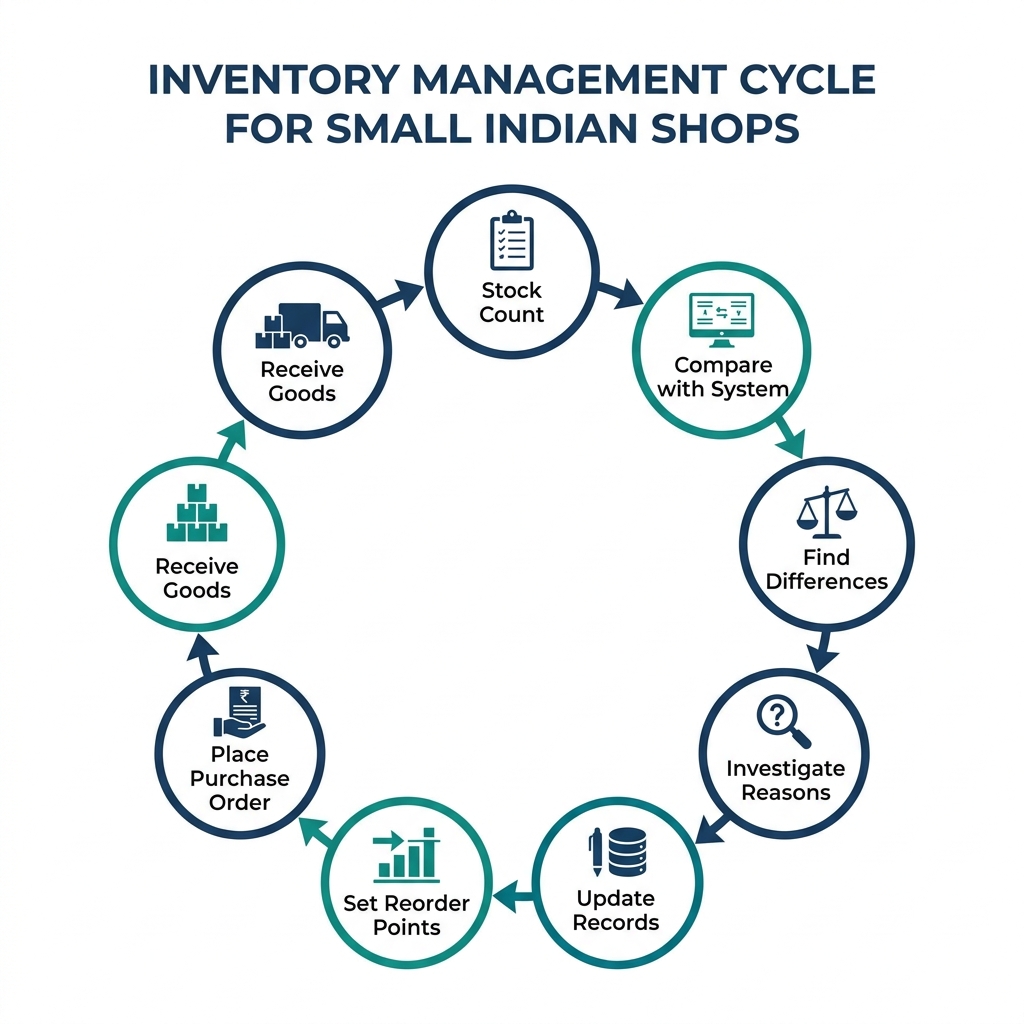
The physical counting discipline nobody wants to follow
I know. Counting stock is boring. Your staff hates it. You hate it. But here's the truth — your billing software is only as accurate as the data you put in.
I've seen shops running Marg ERP for 3 years where the software says they have 150 pieces of a fitting, but the actual shelf has 80. Where did 70 go? Some were sold without billing (cash sales that nobody entered). Some were damaged. Some walked out the door — yes, theft happens, even from trusted staff.
If you don't count, you don't know. And if you don't know, your ordering is just guessing.
The minimum you should do: Pick one shelf, one rack, one category every week. Count it. Match it with your register or software. Write down the difference. That's it. Don't try to count the whole shop in one day — you'll do it once and never again.
The Sunday audit habit
Every Sunday morning, before the shop opens or after it closes for half day, spend 45 minutes on this:
- Pick one product category (say, all adhesives, or all 1-inch fittings)
- Physically count every item in that category
- Open your software — Tally, Vyapar, Marg, whatever you use — and check the number it shows
- Write down differences in a notebook. Yes, a physical notebook. Keep it at the counter.
- If the difference is more than 5%, investigate. Ask your counter staff. Check recent bills.
Do this for 8-10 Sundays, rotating categories each time, and you'll cover your entire shop in 2 months. More importantly, your staff will know that stock is being checked. That alone reduces carelessness and pilferage by 30-40%.
I'm not making that number up. A paint shop owner in Siliguri told me his "unexplained losses" dropped from ₹12,000/month to under ₹3,000 after he started doing weekly checks. His staff didn't suddenly become more honest — they just became more careful.
Reorder points — the one concept that will change your ordering
Forget complicated formulas. Here's the simple version.
Take any item. Let's say you sell 4 boxes of a particular brand of switches per week. Your supplier takes 5 days to deliver after you place an order. So you need at least 4 boxes on hand when you order (to last those 5 days, roughly). Add a buffer of 2 boxes for safety. Your reorder point is 6 boxes.
When your stock hits 6, you order. Not when you "feel" it's low. Not when the shelf looks empty. When it hits 6.
Now do this for your top 50 items. Just 50. These are probably 60-70% of your revenue anyway. Write the reorder point on a small sticker and put it on the shelf next to that item. Your counter boy can check it at closing time — "MCB 32A: 4 boxes left, reorder point is 6, need to order."
Marg ERP has a built-in reorder level feature. So does Vyapar. If you're already paying for the software, use it. Set minimum stock alerts. Most shop owners buy the software and use maybe 20% of its features. That's like buying a Scorpio and never going above second gear.
Dead stock — your money is rotting on the shelf
Look, I'll be direct. Walk into your godown right now and I guarantee you'll find items that have been sitting there for 6 months, 8 months, some even a year. Maybe it was a bulk purchase that seemed like a good deal. Maybe a customer ordered it and never came back. Maybe the product just doesn't sell in your area.
Whatever the reason, that stock is dead. And it's eating your money.
Here's the math that most shop owners refuse to accept. Say you have ₹80,000 of dead stock sitting in your godown. If you had that ₹80,000 as working capital, you could turn it over 3-4 times in a year. At 10% margin per turn, that's ₹24,000-₹32,000 you're losing. Every year. Just by holding onto stuff "in case someone asks for it."
Nobody is going to ask for it. Sell it at cost. Sell it at 10% below cost. Bundle it with popular items. Give it away as a freebie with large orders if you have to. Just get the money back into circulation.
The rule I tell every shop owner: If an item hasn't moved in 90 days, put it on discount. If it hasn't moved in 180 days, sell it at any price. If it's been a year — write it off and learn the lesson.
FIFO isn't just for grocery shops
FIFO — First In, First Out. The stock that came first should sell first. Everyone thinks this is only for milk and bread. Wrong.
If you sell paint, adhesives, sealants, batteries, medicines, cosmetics, or anything with an expiry date — FIFO is non-negotiable. I've seen a hardware shop throw away ₹15,000 worth of expired Fevicol tubes because the new stock was placed in front and the old stock got pushed to the back of the shelf.
₹15,000. Gone. Because someone was too lazy to arrange the shelf properly.
Even for items without expiry dates, FIFO matters. Packaging changes. Prices change. If a company updates their packaging and your shelf still has old-look products, customers think it's duplicate or expired. You end up selling at a discount or not selling at all.
Simple FIFO rule: When new stock arrives, pull old stock to the front of the shelf. Place new stock behind. Every time. No exceptions. Make it a habit for whoever receives deliveries.
The same-day purchase entry rule
This is where 80% of inventory problems begin. Stock arrives at 11 AM. Your counter is busy. You dump the boxes in the godown and tell yourself "I'll enter it in the evening." Evening comes, there are customers. You go home tired. Next morning, more deliveries.
Three days later, you find those boxes while looking for something else. Now you can't remember — did I pay for this? Was it cash or credit? Did I get all the items or was something short?
Same-day entry. Not same-week. Same-day.
When the delivery arrives, take 5 minutes. Open the boxes. Check against the challan. Enter in software. Done. If you use Vyapar or myBillBook on your phone, you can literally do it standing next to the delivery. Scan the items in, note any shortage on the challan, and you're set.
By the way, this also protects you during supplier disputes. "You said you sent 20 pieces, I only got 18." If you marked the shortage on the challan the same day, you have proof. If you noticed it a week later? Good luck arguing.
Minimum stock levels — don't confuse with reorder point
Reorder point tells you WHEN to order. Minimum stock level tells you the absolute lowest you should ever go. They're related but different.
Your minimum stock level is your emergency buffer. For fast-moving items, this might be 2-3 days of sales. For slow-moving items, it might be zero — you order only when a customer asks.
The problem is most shops treat everything as equally important. They stock 6 months of slow-moving items and run out of best-sellers every other week. That's backwards.
Here's a quick way to set priorities. Open your billing software. Pull a sales report for the last 3 months. Sort by quantity sold or revenue. Your top 50 items — these need carefully calculated minimum stock levels and reorder points. Items ranked 51-200 — set rough minimums. Everything else — order on demand.
Tally's stock summary report does this beautifully. Marg ERP's "slow and non-moving items" report is also excellent for identifying which items you should stop stocking altogether.
What your staff needs to know
None of this works if only you care about it. Your counter staff, your godown boy, your delivery person — they all need basic rules:
- No stock goes out without a bill or at least a challan entry
- Every delivery gets counted and checked against the challan before signing
- Damaged items get separated immediately and noted — don't mix them back into selling stock
- New stock goes behind old stock on shelves
- If any item looks like it's running low, tell the owner. Don't assume someone else will notice.
Write these on a chart paper and stick it in the godown. Sounds old-school? It works.
Stock Reorder Points and Safety Thresholds
Common Inventory Pitfalls to Avoid
Pitfall 1: Ordering by intuition instead of data. Shop owners who order "what feels low" end up with cash tied up in slow-moving stock while running out of high-velocity items.
Pitfall 2: Delayed purchase ledger entry. Entering supplier bills weeks late leads to inaccurate stock levels in billing software, defeating automated inventory alerts.
Daily & Weekly Inventory Checklist
- Perform a weekly audit of the top 20 high-value items in stock.
- Input all incoming supplier invoices into the software on the same day they arrive.
- Reconcile physically counted stock with billing database balances weekly.
- Follow FIFO (First-In, First-Out) storage sequence for all items with expiration dates.
A final word about software
Software won't fix bad habits. I've seen shops with ₹50,000 Marg ERP setups that still order by gut feeling because nobody looks at the reports. And I've seen shops running free Vyapar that have tighter stock control than some distributors.
The tool doesn't matter as much as the discipline. Start with a notebook if you need to. Graduate to an app when you're ready. But start.
Your stock is your money. Every box sitting unsold on that shelf is a ₹500 note you can't use. Treat it that way.
Frequently Asked Questions
How often should a small shop do physical stock counting?
At minimum, do a partial count every Sunday — pick one category and count it fully. A complete store-wide count should happen once a month. If you're using billing software like Marg ERP or Vyapar, compare the software numbers against the physical count every month. The gap between software and reality will shock you the first time.
What is the best free inventory management app for small shops in India?
Vyapar and myBillBook both have free tiers that work well for shops with under 500 SKUs. For hardware and auto parts shops with thousands of items, Marg ERP is the industry standard but it's paid. Tally also handles inventory but needs more setup. Honestly, even a well-maintained Excel sheet beats no tracking at all.
How do I calculate reorder point for my shop?
Reorder point = (average daily sales × supplier lead time in days) + safety stock. If you sell 5 units daily and your supplier takes 4 days, your reorder point is (5 × 4) + 5 = 25 units. The extra 5 is your safety buffer for unexpected demand. Calculate this for your top 50 items and you'll cover most of your revenue.
What should I do with dead stock that's been sitting for 6 months?
First, try bundling it with popular items at a small discount. If that doesn't work, sell it at cost or even 10-15% below cost. The money locked in dead stock is costing you more every month in opportunity cost and storage space. I know it hurts to sell below cost, but holding onto it is worse. Get the money back and invest it in items that actually sell.
Is FIFO only for grocery and food shops?
Not at all. FIFO matters for any product that can expire, degrade, or become outdated — paints, adhesives, batteries, medicines, cosmetics, even printer cartridges. Old-packaged stock becomes harder to sell once customers see new packaging in the market. Even for non-perishables, FIFO keeps your shelves looking fresh and current.
My shop has 3,000+ items. How do I even start organizing inventory?
Start with ABC analysis. Your top 10-15% items by revenue are A category — track these weekly. The next 25-30% are B category — track monthly. Everything else is C category — track quarterly. Don't try to track everything with equal effort. If you try to do everything perfectly, you'll end up doing nothing. Focus your energy on the 50-100 items that actually make you money.