
Daily Cash Closing Process — The 10-Minute Routine That Stops Money Leaks in Your Shop
It's 9:30 PM. Shutter's halfway down. Your last customer just left with a bag of electrical fittings. You open your billing software and check the day's total.
₹45,500.
You open the cash drawer and count. ₹2,000 notes — eight of them — ₹16,000. ₹500 notes — thirty-two — ₹16,000. ₹200 notes, ₹100 notes, some fifties and tens. You add it all up.
₹44,100.
₹1,400 short.
Where did it go? You check the UPI payments — ₹12,300 received on PhonePe and Google Pay. You subtract that from the software total. ₹45,500 minus ₹12,300 means ₹33,200 should be in cash. But you only have ₹31,800 in the drawer plus ₹2,300 you gave to the chai boy and for auto-rickshaw expenses. That's ₹34,100.
Wait, now there's an excess of ₹900. Or is there a shortage? The numbers are swimming. You've been standing since 8 AM, your back hurts, and your wife is calling asking when you're coming home.
You know what? You slam the drawer shut. "Kal dekh lenge."
Sound familiar? This happens in thousands of shops across India every night. And that ₹1,400 — or ₹900, or whatever the real number is — just disappears. Not because someone stole it. Because nobody has a system to track it.
Let me show you a system that takes 10 minutes. Not an hour. Ten minutes.
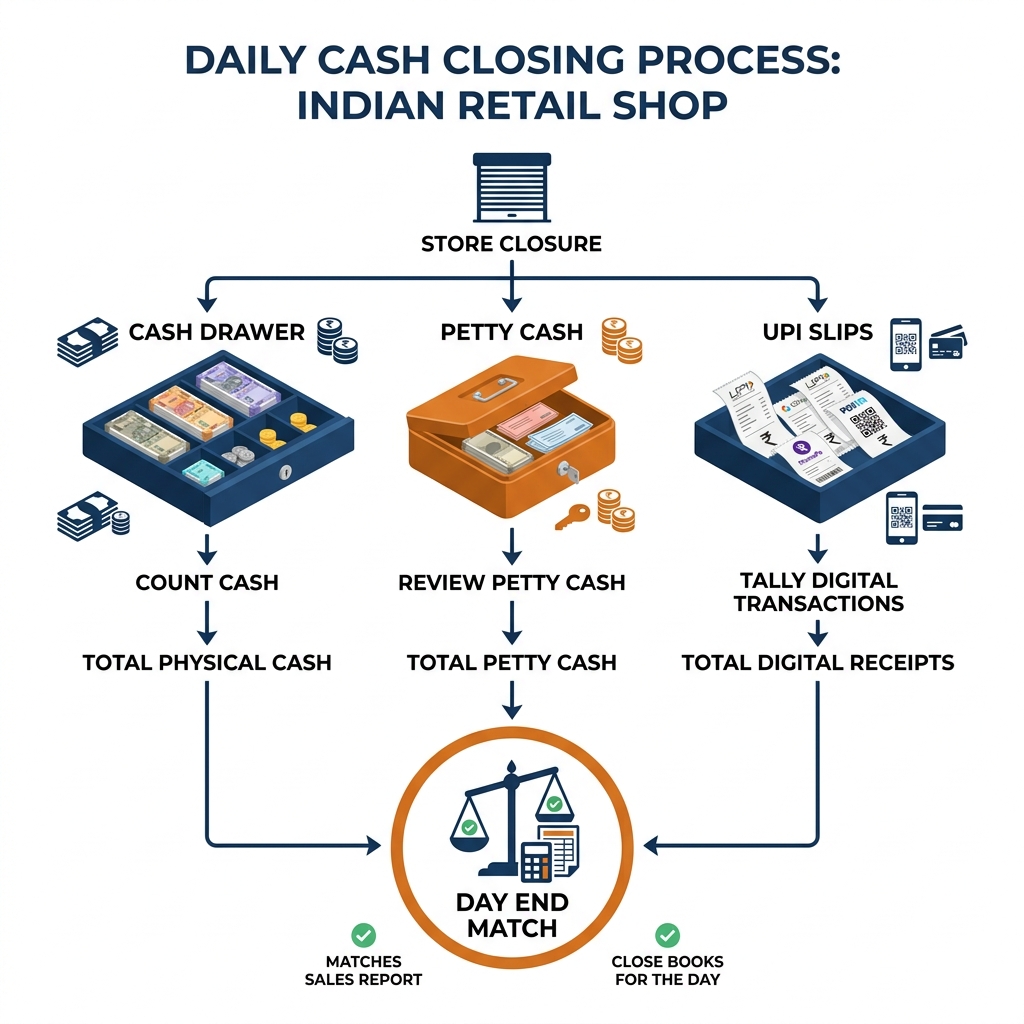
For a deeper dive, read our annual closing and tax preparation guide.
For a deeper dive, read our cash drawer reconciliation format.
For a deeper dive, read our retail audit checklist.
The 3-Tray System
I didn't invent this. I learned it from a provisions store owner in Coimbatore who runs a ₹15 lakh per month business with zero cash discrepancies. Zero. He's been doing this for eleven years.
Here's how it works. You need three trays or boxes. That's it. Three.
Tray 1: Today's Sales Cash
Every rupee that comes in as a cash sale goes here. Only cash from sales. Not change for the next customer, not the ₹200 your delivery boy returned, not the ₹500 advance a customer paid for a future order. Only today's sales cash.
At closing, count this tray. This number should match: [Software total sales] minus [UPI payments] minus [credit sales] minus [card payments].
If it doesn't match, you know exactly where to look — in today's sales transactions.
Tray 2: Change Float
Start every morning with a fixed amount of change. ₹3,000 is a good number for most small shops. Denominations: twenty ₹100 notes, ten ₹50 notes, and ₹500 in coins and small notes.
This tray is used only for giving change to customers. At the end of the day, this tray should still have ₹3,000 worth of cash — just in different denominations than the morning.
If it has less, someone dipped into the change tray for something else. If it has more, some sales cash got mixed in. Either way, the problem is visible.
Tray 3: Petty Cash and Expenses
Chai, courier charges, auto fare for delivery, pen and paper from the stationery shop next door, the ₹150 you gave the electrician for a tube light replacement — all of this comes from Tray 3.
Rule: no cash leaves this tray without a slip. A small notepad, a pen, and a box. Write the amount, write what it was for, put the slip in the box, take the cash. At closing, count the remaining cash plus all the slips. The total should match the morning opening amount of Tray 3.
Most shops start Tray 3 with ₹2,000 to ₹5,000 depending on typical daily expenses.
Why Three Trays Instead of One Drawer?
Because a single drawer is chaos. Sales cash, change, expense cash — it all mixes together. When you count at night, you're counting one big pile and trying to figure out what portion is what. It's like pouring dal, chawal, and sabzi into one bowl and then trying to weigh each separately.
Three trays give you three separate numbers to verify against three separate records. Problem is immediately localized.
Short in Tray 1? Billing problem — check today's invoices.
Short in Tray 2? Someone used change money for something else.
Short in Tray 3? Missing expense slip.
Takes the guesswork out completely.
The PhonePe / Google Pay / BharatPe Problem
UPI has made sales easier but reconciliation harder. Here's why.
A customer buys ₹3,200 worth of goods. He pays ₹2,000 on PhonePe and ₹1,200 in cash. Your billing person creates one invoice for ₹3,200. But does he record the payment split? In most shops, he doesn't. The software shows ₹3,200 as a sale. At closing, you assume all ₹3,200 should be in cash. But only ₹1,200 is.
₹2,000 "shortage" that isn't a shortage at all. It's sitting in your PhonePe account.
Now multiply this by 30-40 split transactions a day. The confusion is massive.
Here's how to fix it:
Your billing software should have a payment mode option. Every invoice — every single one — should be marked as Cash, PhonePe, Google Pay, BharatPe, Card, or Split. If it's split, enter the exact amounts.
In Tally, when you receive payment, you can split it across multiple ledgers — Cash, PhonePe Bank Account, GPay Bank Account. Create separate ledgers for each UPI app. Yes, it takes 10 extra seconds per invoice. Those 10 seconds save you 30 minutes of confusion at night.
In Vyapar and myBillBook, there are dedicated payment mode buttons. Use them.
At closing, open each UPI app and check the transaction list for today. Total received on PhonePe should match PhonePe entries in your software. Same for Google Pay. Same for BharatPe.
By the way — one common trap. If you use the same PhonePe account for personal and business transactions, you will never get this right. Never. Get a separate business UPI ID. It costs nothing. Open a current account if you haven't already and link a UPI ID to that.
The ₹50 Rule
Here's a practical rule that works in shops of all sizes: if the cash difference at closing is under ₹50, log it and move on. Don't spend 45 minutes hunting for ₹30.
Small differences happen. A customer gives you ₹507 and you give back ₹10 instead of ₹7. A coin rolls under the counter. The billing software rounds off differently than you do. These tiny leaks are normal.
But — and this is important — log every shortage and surplus. Keep a small register. Date, shortage/surplus amount, that's it. At the end of the month, look at the totals.
If shortages are consistently under ₹50 per day and roughly balance out with surpluses, you're fine. Normal shop operation.
If shortages are consistently ₹200-₹500 per day with no surpluses? That's not rounding errors. That's a system problem or, let's be honest, a people problem.
Staff Accountability Without Being a Tyrant
Look, I know this is a sensitive topic. Most shop staff in India are loyal, hardworking people. I'm not suggesting you treat your billing person like a suspect. But accountability and suspicion are different things.
If two people handle the cash drawer during the day — say you and your helper, or two shift staff — each person should count the drawer when they take over. Write it down. When they hand over, count again. Write it down.
This isn't distrust. This is protection — for both of you. If a shortage shows up at night, you know exactly which shift it happened in. Without this, the morning person blames the evening person, the evening person blames the morning person, and you blame your luck.
One more thing — whoever does the billing should NOT be the same person who counts the cash at closing. That's basic internal control. If the same person creates the invoice and handles the cash, there's no cross-check. Even if you trust him completely, it's a bad system because mistakes go unnoticed.
You count, he bills. Or he counts, you verify. Two pairs of eyes.
The 10-Minute Closing Checklist
Here's the exact routine. Do this every night. Time yourself the first few days — it really does take just 10 minutes once you've done it a few times.
Step 1 (1 minute): Close all pending invoices in the billing software. No half-typed bills, no "I'll save it tomorrow." Everything saved and closed.
Step 2 (2 minutes): Print or note the Day Summary from your billing software. You need four numbers: total sales, total cash received, total UPI received, and total credit sales.
Step 3 (3 minutes): Count Tray 1 (sales cash). Write the number down. Compare it with: [total cash received from software]. Match? Move on. Mismatch? Mark it.
Step 4 (1 minute): Count Tray 2 (change float). Should be the same as the morning amount. If not, note the difference.
Step 5 (1 minute): Count Tray 3 (petty cash). Add remaining cash plus all expense slips. Should equal the morning starting amount. If not, find the missing slip.
Step 6 (1 minute): Open PhonePe/Google Pay/BharatPe. Check today's total received. Compare with software UPI totals. Match? Done.
Step 7 (1 minute): Record everything in the closing register. Date, sales total, cash counted, UPI total, petty expenses, shortage or surplus. Sign it.
That's it. Seven steps, ten minutes, zero confusion the next morning.
What About Card Payments and Paytm Wallet?
Same principle. Each payment method gets its own tracking. Card payments settle into your bank account after 1-2 business days, so you won't see the cash today — but your software should show today's card sales. At the end of the week, check your bank statement against the card sales total.
Paytm wallet payments (not UPI, the actual wallet) have a separate settlement cycle. Track them separately. And if you're using Paytm for Business, download the daily settlement report from the dashboard.
I know this feels like a lot of tracking. But here's the thing — once you set it up, it takes less time than the current system of "stare at the drawer and wonder where ₹1,400 went."
The Morning Side of Cash Closing
Good closing starts with good opening. Before you open the shop, set up your three trays:
- Tray 1: Empty (sales cash will accumulate during the day)
- Tray 2: ₹3,000 in change (or whatever your fixed float is)
- Tray 3: ₹2,000-₹5,000 in petty cash (refilled if needed)
Write down the opening amounts. This is your baseline for the night. Takes 2 minutes.
The big mistake I see: shops carrying over yesterday's cash in the drawer. ₹44,000 sitting in the drawer from last night, plus today's sales, plus change, minus expenses — how are you going to sort that out tonight?
Deposit yesterday's sales cash in the bank. Start each day fresh. If you can't go to the bank daily, at least separate yesterday's cash into an envelope and keep it aside. Don't mix days.
Summary of the 3-Tray Cash System
When the System Catches Real Problems
A garment shop owner in Ranchi started using this system in March. By the second week, he noticed consistent shortages of ₹300-₹400 every Tuesday and Thursday. Those were the days his shop helper managed the counter alone while the owner went for stock purchases.
He didn't accuse anyone. He just started checking the CCTV on those specific days. Turned out the helper was giving 10-15% discounts to his friends and relatives without billing them. On a ₹3,000 kurta, he'd bill ₹2,600 and pocket the difference.
₹400 per day, twice a week, over 6 months = ₹20,800. Not life-changing money, but it was coming straight from the owner's pocket.
Without the daily closing system, this would have gone unnoticed for years. The monthly bank statement wouldn't catch it because the sales were still being billed — just at lower amounts.
The 3-tray system catches problems early. Small problems, before they become expensive habits.
Frequently Asked Questions
How much cash difference is acceptable during daily closing?
I use the ₹50 rule. Under ₹50, log it and move on — it's usually rounding or coin errors. Over ₹50, investigate before anyone goes home. If you're seeing differences above ₹50 more than twice a week, something is wrong with your process. Track every shortage and surplus in a register and review the monthly pattern.
How do I reconcile PhonePe and Google Pay payments with my billing software?
At closing, open each UPI app and check the day's transaction list. Total received should match what your billing software shows under that payment mode. If there's a mismatch, check for missed entries, duplicate entries, or personal transactions mixed in. The most common error is split payments — customer pays part cash, part UPI — that the billing person didn't record correctly. Download the daily statement from the app and keep it as backup.
Should I keep a separate petty cash box or use the main cash drawer?
Always separate. The main drawer is for sales cash only. Petty cash should be in its own box with a fixed starting amount — ₹2,000 to ₹5,000 works for most shops. Every withdrawal gets a slip. No slip, no cash. Reconcile the petty cash box separately during your nightly closing. If you mix petty cash with sales cash, you'll never figure out where the differences are coming from.
What should I do if there is a big cash shortage at closing?
Big means anything over ₹500. First, recount. Seriously — recount properly. Then check: are there unbilled sales? Did someone pay UPI but the bill shows cash? Any void or cancelled bills where the cash wasn't returned to the drawer? Any credit sale that wasn't recorded? Check petty cash slips. If everything checks out and the shortage is still there, note it in the register with full details and check CCTV if you have it. Don't let it slide — ₹500 today becomes ₹5,000 next month.
How do I handle cash received for previous credit sales during daily closing?
This trips up a lot of people. If a customer comes in and pays off a ₹4,000 due from last week, that's not a sale — it's a receipt against a previous invoice. Enter it as a payment receipt in your billing software, linked to the original invoice. This reduces the customer's outstanding balance without inflating today's sales number. In Tally, use a Receipt Voucher (F6) against the customer's ledger. The cash goes into Tray 1 but your closing calculation accounts for it separately.
Is it worth buying a cash counting machine for a small shop?
If you handle more than ₹20,000 in notes daily — yes, absolutely. A basic cash counting machine costs ₹3,000 to ₹6,000 on Amazon. It counts notes in 10 seconds flat and catches counterfeit notes. I've seen shops receive fake ₹500 notes at least once a month. One fake note caught and the machine has paid for itself. Plus, it makes your nightly counting 15 minutes faster. That's 7.5 hours saved per month.