
Customer Due Tracking System for Small Shops — Stop Losing Money to Udhar
Raju bhai comes to your counter every week. Buys ₹5,000-₹8,000 worth of material on credit. Pays something random — ₹3,000 one week, ₹2,000 the next. Sometimes nothing. After 3 months, you tell him his due is ₹45,000. He says it's ₹28,000.
Who's right?
Neither of you knows. Because nobody wrote it down properly. You have a rough entry in a bahi khata with dates missing. He has nothing. And now a ₹17,000 gap is about to turn into a relationship-ending argument.
I've seen this exact fight play out in shops across Bihar, Jharkhand, West Bengal — everywhere. The amounts change, the story stays the same. Credit without tracking is not business. It's charity with extra steps.
The real cost of untracked udhar
Let me hit you with some math. Say you run a building material shop doing ₹12 lakh monthly sales. About 40% is on credit — that's ₹4.8 lakh going out every month on trust. If even 5% of that becomes disputed or unrecoverable, you're losing ₹24,000 per month. That's ₹2.88 lakh per year.
Now think about what ₹2.88 lakh means for a shop with maybe 10-12% net margin. You'd need to sell an extra ₹24-29 lakh of goods just to cover that loss. Just to break even on money you already sold.
That's not a small number. That's a staff salary gone. That's your Diwali stock money gone.
But wait — the number above only covers the dues you lose entirely. What about the dues that come in late? If ₹2 lakh is sitting as outstanding for 60-90 days, that's your working capital someone else is using for free. You're basically giving interest-free loans to your customers while paying 14-18% interest on your own CC limit or overdraft.
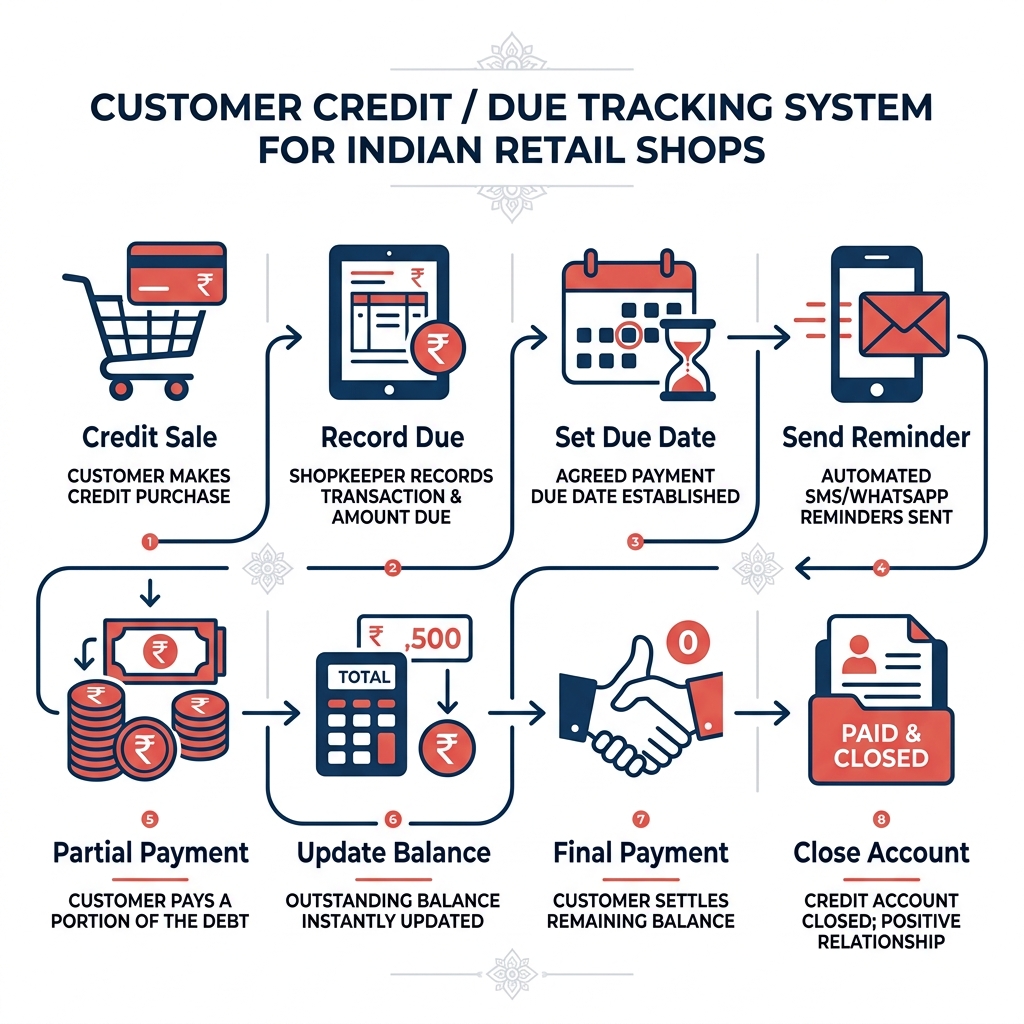
Step 1: Set credit limits — and actually stick to them
Every customer who buys on credit from your shop needs a limit. No exceptions. Not even your cousin's friend who "always pays eventually."
Here's how to set it. Look at a customer's average monthly purchase. Their credit limit should be 1 to 1.5 times that amount. So if someone buys ₹20,000 worth of material monthly and pays within 30 days, their limit is ₹20,000-₹30,000.
When they hit the limit? Cash only. No bill goes out on credit until they clear some of the existing balance.
"But they'll go to the next shop!"
Maybe. But the next shop will face the same problem. And honestly, a customer who doesn't pay you on time is not a customer — he's a liability. Let the next shop deal with him.
I know this sounds harsh. But I've watched too many shopkeepers bleed money being "nice." You can be polite and firm at the same time. Frame it as a shop policy. "Yeh humara naya system hai, sabke liye same rule hai." When it's a policy, people accept it. When it seems personal, they fight.
Step 2: Track every rupee — partial payments especially
Here's where most shops fall apart. The sale gets recorded. But the partial payment? Written on a loose slip. Or noted on the back of an invoice. Or just remembered ("haan, usne 3000 diye the kal").
No.
Every payment — full or partial — needs to go into your billing software or ledger with three things: the date, the amount, and which invoice it's being applied to. That last part is what everyone misses.
Let me explain why it matters. Say Raju bhai has three unpaid invoices: ₹8,000 from March 2, ₹12,000 from March 15, and ₹5,000 from March 28. He comes in and pays ₹10,000. Which invoice does this clear?
If you just reduce the total outstanding by ₹10,000, you'll never know which invoices are actually old. For aging analysis — which I'll talk about next — you need to know that the March 2 invoice of ₹8,000 is fully paid, the March 15 invoice is partially paid (₹2,000 applied), and the March 28 one is untouched.
Vyapar does this well. Tally does it very well. Even Khatabook handles basic payment tracking. But you need to actually enter the data. Every time. Same day.
Step 3: Aging analysis — your early warning system
Aging analysis is a fancy term for a simple question: how old are the unpaid invoices?
Divide your outstanding into buckets:
- 0-30 days: Normal. This is current credit.
- 31-60 days: Yellow flag. Call and remind.
- 61-90 days: Red flag. Stop new credit. Visit in person if needed.
- 90+ days: Danger. This money is at serious risk of becoming a bad debt.
Run this report every 15th and 30th of the month. Tally generates it automatically — it's called the "Receivables Aging" report under Outstanding. Marg ERP has it too. If you're using a notebook, you'll have to create this manually, which is painful but still doable.
The point of aging analysis isn't to collect numbers. It's to take action. When you see a ₹35,000 balance in the 61-90 day bucket, that's not a number on a report — that's a customer you need to call TODAY. Not next week. Today.
Step 4: The reminder process — soft to hard
Most shop owners either never remind customers (too polite) or go straight to aggressive demands (too abrupt). You need a process.
Day 30: A casual mention at the counter next time they visit. "Bhai, ek purana bill pending hai, ₹8,000 wala. Dekh lena." Keep it light.
Day 45: WhatsApp message. Something like: "Namaste Raju bhai, aapka ₹8,000 ka bill dated 15 March pending hai. Request hai ki is week settle kar dein. Dhanyavaad." Professional, not angry.
Day 60: Phone call. Direct conversation. "Bhai, do mahine ho gaye. Mujhe bhi payments karne hain, please is hafte clear kar do."
Day 75: Visit in person or send someone. This usually works because it shows you're serious.
Day 90: Written notice on letterhead. At this point you're protecting yourself legally as much as trying to collect.
Keep notes of every reminder. Date. What was said. What they promised. This matters if things ever go legal — and for amounts above ₹50,000, sometimes they do.
The WhatsApp receipt trick
This is something I started recommending to shop owners about two years ago, and it has saved so many disputes.
Every time a customer buys on credit, send them a WhatsApp message with the bill photo or a simple text: "Invoice #1247 — ₹7,500 — 15 March 2026 — Pending." Every time they make a payment: "Payment received ₹3,000 — Balance ₹4,500 — 28 March 2026."
That's it. Takes 30 seconds.
Now both of you have a record. In the same chat. With timestamps that WhatsApp creates automatically. When they come back saying "mera toh sirf ₹2,000 baki hai," you scroll up and show them the messages. Conversation over.
Vyapar can send invoices directly via WhatsApp. myBillBook does this too. If you're not using software, just type it out manually or take a photo of the invoice and send it.
By the way, this also works as a gentle reminder. Every time they see that "Balance ₹4,500" message in their chat, it's sitting there, quietly reminding them. No awkward phone call needed.
Step 5: When to stop credit — the hard decision
Nobody likes cutting off a customer. Especially a regular one. But here are clear signals that it's time:
- Their outstanding has crossed 90 days and they haven't acknowledged it or made any part payment
- They've bounced a cheque
- They dispute amounts regularly and never agree with your records
- Their total outstanding is more than 2x their monthly purchase volume
- They've started buying from competitors but still owe you money
When you see two or more of these signs, stop credit. Don't give "one more chance." Every shopkeeper who gave one more chance has a story about how it cost them.
A plumbing shop owner in Patna told me about a contractor who owed him ₹1.7 lakh. The contractor kept promising "next week." The shop owner kept supplying because the contractor was giving him "big orders." After 6 months, the contractor vanished. Shifted to another city. ₹1.7 lakh — gone forever.
The sad part? There were signs at month 2. Payments were slowing. Excuses were increasing. But the shop owner didn't want to lose the "big customer." He lost a lot more.
Approval hierarchy — don't let your counter boy give ₹50,000 credit
If you have staff handling the counter, you need clear rules about who can approve credit and how much.
A simple setup:
- Counter staff can issue credit up to ₹5,000 to existing customers with clean records
- Anything above ₹5,000 needs the owner's or manager's approval
- New customers — no credit for the first 3 purchases. Cash only.
- Any customer whose outstanding is already above 80% of their limit — no credit without owner's OK
I've seen counter boys extend ₹25,000 credit to someone's "friend" who walked in with a phone number reference. That ₹25,000 was never seen again. The counter boy said "woh bol rahe the ki malik ko pata hai." The malik didn't know.
Set rules. Write them down. Put them at the counter. No verbal approvals.
Credit Due Aging Schedule and Collection Policy
Common Customer Credit Mistakes
Mistake 1: Not setting hard credit limits. Allowing a customer to keep buying on credit without a cap because they are a regular contact inevitably leads to collection default.
Mistake 2: Missing balance confirmations. Failing to get written confirmations on outstanding balances allows disputes about outstanding rupee amounts to drag on for months.
Credit Management Checklist for Shop Owners
- Assign a specific credit limit in the billing software for every approved ledger.
- Deliver a digital WhatsApp receipt showing the updated outstanding balance after every transaction.
- Perform a monthly reconciliation of ledger balances with credit customers.
- Restrict counter assistants from authorizing credit sales without manager approval.
Using billing software credit reports properly
If you're using Tally, Vyapar, or Marg ERP, you already have credit tracking tools. The question is whether you're using them.
Here's what you should look at every week:
- Customer outstanding report — sorted by amount, highest first. Your top 10 debtors probably account for 70% of your total outstanding.
- Aging report — how much is in 30-60-90 day buckets
- Payment receipt register — did the payments you expected this week actually come in?
- Customer-wise profitability — this one is eye-opening. Sometimes your biggest buyer by volume is your worst customer by profitability because they take maximum credit, negotiate maximum discounts, and return maximum goods.
Spend 20 minutes every Monday morning on these four reports. That's it. 20 minutes can save you thousands.
One more thing — document everything from day one
The best time to set up a credit tracking system was when you opened your shop. The second best time is today. Don't wait for a dispute to motivate you. By then you've already lost money.
Start simple. Open a fresh page in your register or create a new customer ledger in your billing app. Start entering today's credit sales with proper details. The past is gone — you can try to reconstruct it, but focus on getting the system right from today forward.
Your money. Your rules. Write them down.
Frequently Asked Questions
How do I set credit limits for customers without offending them?
Frame it as a shop policy, not a personal decision. Say "We've started a new system — every customer gets a credit limit based on their monthly purchases." When it's a policy that applies to everyone, people rarely take offense. Start with new customers first and then slowly extend to existing ones. Most people understand — they face the same issue in their own businesses.
What if a customer disputes the outstanding amount?
This is exactly why you need a system that records every transaction with dates and sends receipts. If you use Vyapar or Tally, pull the customer ledger and show them every invoice and payment entry. If you've been sending WhatsApp receipts after every transaction, you have a chat history both parties can check. Without records, disputes turn into arguments. And in arguments, the shop owner always loses the relationship and often the money too.
Should I charge interest on overdue credit?
For retail customers, charging interest usually causes more trouble than it's worth — they'll just go to another shop. For B2B customers, contractors, and institutional buyers, it's common to have a written agreement with 1.5-2% monthly interest on payments beyond 30 days. But this needs to be agreed in writing BEFORE you extend credit, not slapped on after the fact.
Which app is best for tracking udhar and customer dues?
Vyapar, myBillBook, and Khatabook are popular choices. Vyapar is good because it integrates billing with credit tracking — you don't need two apps. Khatabook is simpler, works well if you only need basic due tracking. For larger shops doing ₹20 lakh+ monthly, Tally and Marg ERP have proper accounts receivable with aging reports, credit limit controls, and automated reminders.
When should I completely stop giving credit to a customer?
Stop when their dues are past 90 days with no acknowledgment or payment effort. Stop if they bounce a cheque. Stop if they regularly argue about amounts. Stop if their outstanding crosses 2x their monthly average purchase. And definitely stop if you hear they're buying from your competitor on cash while owing you money. Better to lose a sale than add to a bad debt.
How do I recover old dues that have been pending for months?
Start with a polite WhatsApp message listing all pending invoices with dates and amounts. Follow up with a call after a week. No response? Visit in person. For serious amounts, send a written notice on your shop letterhead. For amounts above ₹25,000, you can consult a local lawyer about sending a legal notice — costs ₹2,000-5,000 but the notice itself often scares people into paying without actually going to court. Just make sure you have documentation of the original sale.