
Small Shop Loyalty Programs: Protect Margins & Retain Customers
Ramesh Patel, owner of Patel Hardware & Paints in Ahmedabad, stood at his billing counter. A customer had selected items worth ₹10,000 (plumbing pipes, adhesive cans, and hand tools). As Ramesh began printing the bill, the customer smiled and said: "Patel bhai, hum toh aapke purane aur regular customer hain, thoda discount toh banta hai." (Patel bhai, we are your regular customer, we deserve some discount).
Ramesh did what most small shop owners do to maintain customer goodwill. He offered a flat 5% discount (reducing the bill by ₹500) and charged him ₹9,500. The customer left happy, feeling he had won a small victory.
But let's look at the financial math Ramesh ignored. The wholesale cost of those items was ₹8,000. Ramesh's fixed operating costs (rent, electricity, and salaries) average out to 10% of sales, which is ₹1,000. This meant his actual net profit on that sale was supposed to be ₹1,000 (a 10% net profit margin). By giving a flat ₹500 cash discount at the counter, Ramesh did not just lose ₹500; **he gave away 50% of his entire net profit margin.** To recover that ₹500 loss, Ramesh now has to sell an additional ₹5,000 worth of hardware just to break even.
This is the discount illusion. In Indian retail, shopkeepers use discounts as their primary customer retention tool. However, unstructured, informal discounts directly cannibalize your profits. Customers soon expect discounts as a right, and you find yourself working longer hours for diminishing returns. You can analyze your own margins and break-even points using our Shop Profit Margin Calculator Guide.
To break this cycle, you must shift from flat discounts to structured, margin-safe loyalty programs. This guide shows you how to design a reward point system that retains customers without draining your profitability.
The Direct Margin Impact of Retail Discounts
Many shop owners do not understand the leverage of pricing. A small discount has a disproportionately large impact on your net profits. The table below illustrates the sales volume increase required to maintain your profit levels after offering a discount (assuming a starting gross margin of 20%):
As the data shows, if you give a 10% discount, you must sell twice as many products to earn the same amount of net profit. Informal discounting is a fast track to financial trouble. A loyalty program resolves this by deferring the reward to the next purchase, ensuring the customer must return to capture the benefit.
Step 1: Shift to a Points-Based Reward System
Instead of giving a customer a discount today, enroll them in a loyalty program that rewards them with points redeemable on future visits. This creates a psychological "hook." When a customer has ₹150 worth of points sitting in your store's database, they are far less likely to visit your competitor across the street.
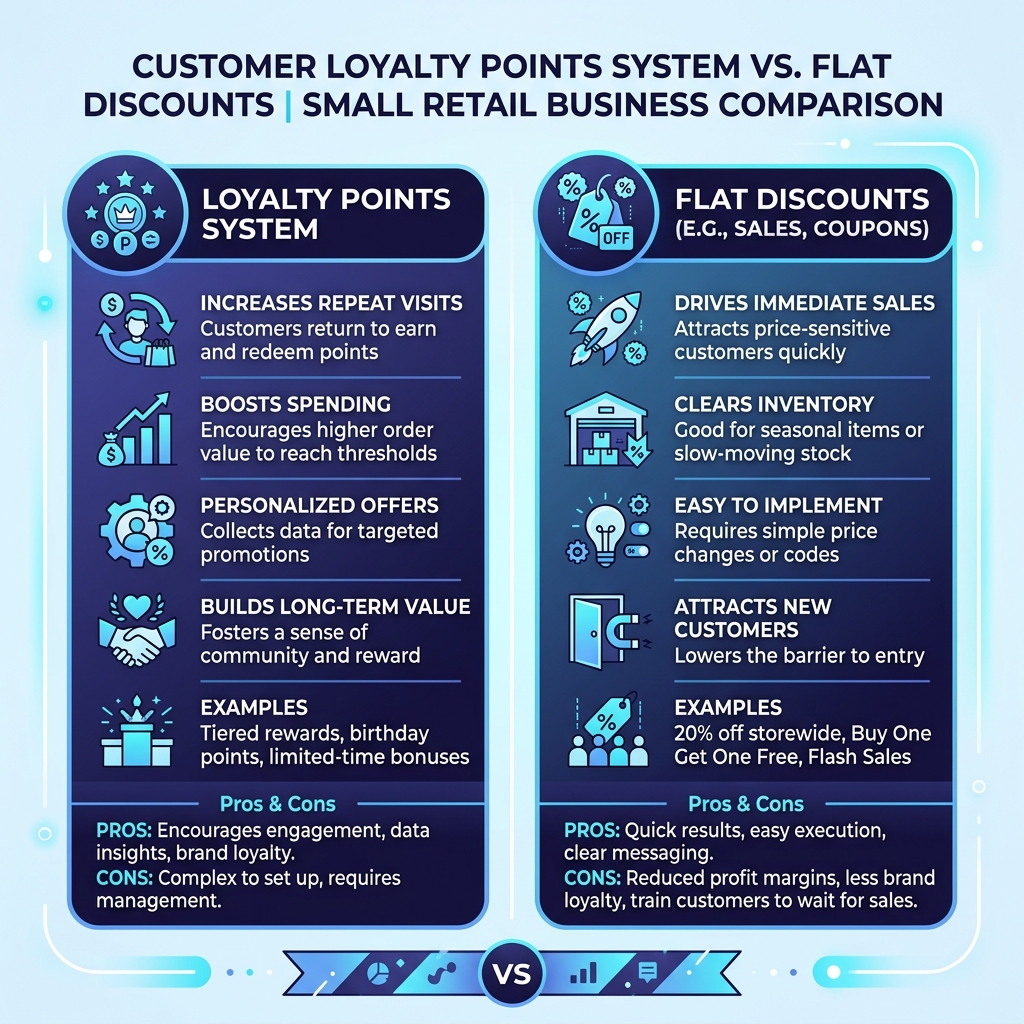
To implement this, you need to collect a basic customer identifier—their **mobile number**—at the checkout counter. This mobile number serves as their account ID. Most modern billing software (like Tally, Vyapar, or Busy) has built-in customer relationship management (CRM) modules that allow you to credit points automatically during billing. If you are choosing billing software, refer to our comparison guide: Cloud vs Offline Billing Software.
Step 2: Reward Points Calculation and Math
A loyalty program must be mathematically designed to preserve your margins. Never guess your reward rates. Apply these three structural rules:
1. The 1% Golden Rule
For standard retail stores, your reward rate should hover between 1% and 2% of the transaction value. The recommended formula is:
If a customer buys goods worth ₹5,000, they earn 50 points (worth ₹50). This is equivalent to a 1% discount, but because it is deferred, it only costs you money if they return to spend more. It is far safer than giving a 5% or 10% flat discount today.
2. The Redemption Threshold
Do not allow customers to redeem points immediately on their next tiny purchase. Set a minimum accumulation threshold. For example, points can only be redeemed once the balance reaches **100 points** (representing ₹10,000 in total historical purchases), and can only be applied to bills exceeding ₹1,000. This protects you from small-value transactions eroding your margin.
3. The Expiration Date
Points should not sit on your books forever as an open liability. Set a clear expiration limit (e.g., points expire after 6 months or 12 months). This creates urgency. You can send a WhatsApp reminder: "Sharma ji, your ₹150 loyalty points at Patel Hardware are expiring on June 30. Visit us this week to redeem them!" This drives foot traffic during slow periods.
Step 3: Creating a Margin-Protecting Discount Policy
Not all inventory is created equal. Some items have comfortable margins (like tools or designer fittings), while others have razor-thin margins (like cement, steel rods, or bulk paint cans). If you give loyalty points or discounts on low-margin commodities, you will lose money on every sale.
Establish these policy rules:
- Exclude Low-Margin Categories: Configure your POS software to exclude low-margin brands or commodity categories from earning points. If a customer buys ₹8,000 worth of cement (thin margin) and ₹2,000 worth of paintbrushes (high margin), points should only be calculated on the ₹2,000 paintbrush portion.
- No Points on Credit (Udhar) Sales: This is a critical rule for Indian retail. If a customer buys on credit, they should not earn loyalty points. Points should be reserved exclusively for cash, UPI, or card payments. This encourages customers to pay immediately, reducing your outstanding dues. For tips on managing credit accounts, see our guide on Customer Credit Policies.
- Restrict Return and Exchange Points: If a customer returns a product, the points earned on the original purchase must be deducted from their loyalty account. To set up a structured return policy, read our guide on Retail Return & Exchange Policies.
Step 4: Tracking Customer Retention Metrics
The goal of a loyalty program is not just to give rewards; it is to collect data that helps you understand customer behavior. You should monitor two key metrics monthly:
- Repeat Purchase Rate (RPR): What percentage of your customers return to buy from you again? Calculate it by taking the number of unique customers who made 2 or more purchases in a month and dividing it by the total number of active customers in your database. A healthy retail store should have an RPR above 45%.
- Customer Lifetime Value (LTV): How much total profit does a customer bring to your store over their lifetime? By tracking their shopping history through their mobile number, you can identify your top 10% highest-value customers and offer them special previews or service priorities.
Step 5: Counter Scripts to Handle Discount Requests
The biggest hurdle in moving away from discounts is the face-to-face negotiation at the counter. Your sales staff must be trained to handle these conversations professionally. Give them a clear script:
"Sir, we have stopped manual cash discounts to keep our prices low and fair for everyone. However, we have launched our new Loyalty Reward Program. Your mobile number is now registered, and today's purchase has earned you 100 points (worth ₹100). These points are credited to your account, and you can use them as direct cash on your next bill. It is a permanent benefit for our regular customers."
When customers see that the policy is automated and applies to everyone, they accept it. It shifts the relationship from haggling to building long-term mutual value.
Frequently Asked Questions
Why are flat discounts bad for a retail store's financial health?
A flat discount is deducted directly from your net profit, not your sales revenue. If your gross margin is 20% and operating costs are 10%, your net profit margin is 10%. Giving a flat 5% discount cuts your net profit in half (50% reduction). You must double your sales volume just to make the same amount of profit, which is unsustainable for most retail businesses.
How do we calculate the value of reward points for a loyalty program?
A standard, margin-safe structure is: Spend ₹100 = Earn 1 Point. 1 Point = ₹1 value (equivalent to a 1% reward rate). To encourage redemptions, set a minimum threshold, such as requiring customers to accumulate at least 100 points before they can redeem them, and set an expiration date of 6 to 12 months to drive repeat visits.
Should we give loyalty points on credit (udhar) purchases?
No. Loyalty programs are designed to incentivize profitable customer behavior. Credit purchases carry collection costs, interest costs on working capital, and risk of default. Establish a clear policy: points are only earned on immediate cash, UPI, or card payments. This acts as a powerful incentive for customers to pay cash instead of asking for udhar.
How do I exclude low-margin items from a loyalty program?
In your POS billing software, configure your inventory settings to classify items by brand or category. Mark low-margin commodity products (like cement in a hardware store, or loose sugar in a grocery store) as "Non-Qualifying Items" for points. When these items are scanned, the billing software will automatically calculate points only on the remaining high-margin products in the cart.
What is Repeat Purchase Rate (RPR), and how do I track it?
Repeat Purchase Rate is the percentage of your customer database that buys from you more than once in a given period (e.g., a quarter). You track it by requiring a customer mobile number at checkout. In your billing software, divide the number of unique customers who made 2 or more purchases by the total number of unique customers. A healthy retail RPR should be above 45%.
What is the best way to handle customers who insist on cash discounts instead of points?
Politely explain that your prices are already optimized and the system does not allow manual discount overrides. Offer a script: "Sir, our system now uses automated point rewards. Today, your purchase earned ₹100 worth of points that are credited to your mobile number. You can use them on your next visit. The computer won't let us deduct cash today, but this is a permanent benefit for you."